
Revolutionizing Engineering with AI: A Game-Changer in Data Creation
January 19, 2024 · Rashaad Sader
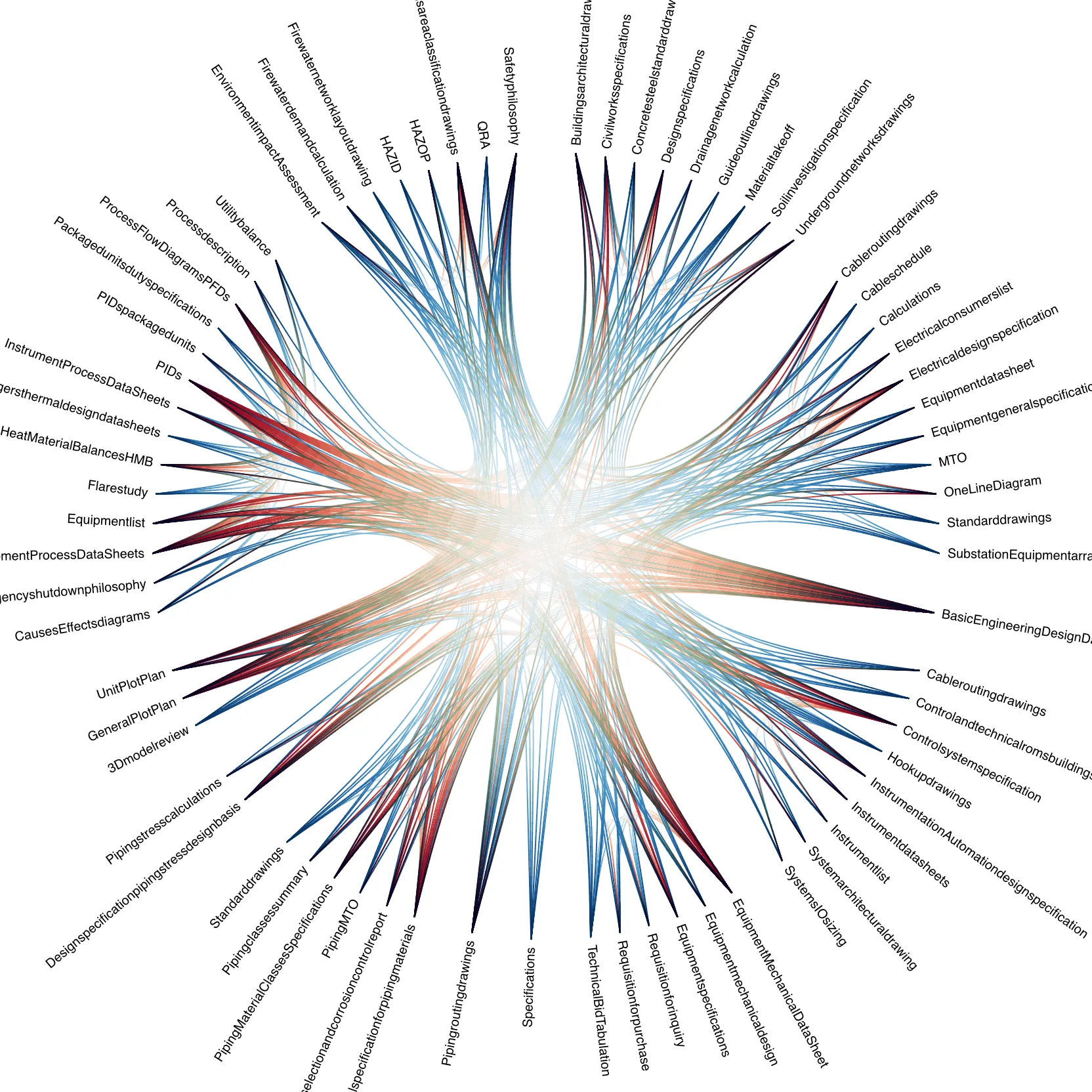
The recent breakthroughs in Large Language Models such as GPT-4 and Llama 2 have unlocked something the engineering world has long needed: the ability to generate meaningful data where it simply did not exist before. In an earlier article we explored how AI can summarize contracts. This time we want to share something even more ambitious — using AI to map the deliverables that drive every engineering project.
The Challenge
Every engineering organization runs on a complex network of deliverables — drawings, specifications, calculations, datasheets, and reports — each one feeding into the next. Mapping that network is hard. Static flowcharts take weeks of effort to create, and once they exist, they sit in a drawer because they are too dense to read and impossible to interact with. The people who need them most rarely get value from them.
The Breakthrough
We deployed AI systems to build comprehensive databases of engineering deliverables for both the FEED and Detailed Engineering phases. The model catalogs each deliverable, writes a description of what it is, and identifies which other deliverables depend on it and which it depends on in turn. The result is a structured dataset that could not have been produced by hand in any reasonable timeframe.
The Result
That dataset becomes a visual, navigable tool — a living roadmap that shows how every piece of an engineering project connects. New engineers use it to orient themselves. Seasoned engineers use it to spot dependencies they may have missed. Project managers use it to plan sequencing and reduce rework.
Accuracy and Efficiency
In our initial testing the AI-generated relationships sit at roughly 80% accuracy out of the gate. The remaining gap closes quickly: a small group of engineers can refine the network in about a week, turning an 80% solution into a deployable one. Compared with the months of effort traditional flowchart-building takes, the trade is obvious.